Copywriting
Cold Email Subject Lines: 40 Examples and the Rules Behind Them
By Kaysid Team · · 5 min read
The subject line has one job in cold email: make the right person think "this is for me" in the half second they spend scanning their inbox. Not to be clever, not to sell. Just to earn the open.
Here are the rules that make cold email subject lines work in 2026, 40 examples you can adapt, the patterns that hurt deliverability, and how to test subject lines without fooling yourself.
The rules of a good cold email subject line
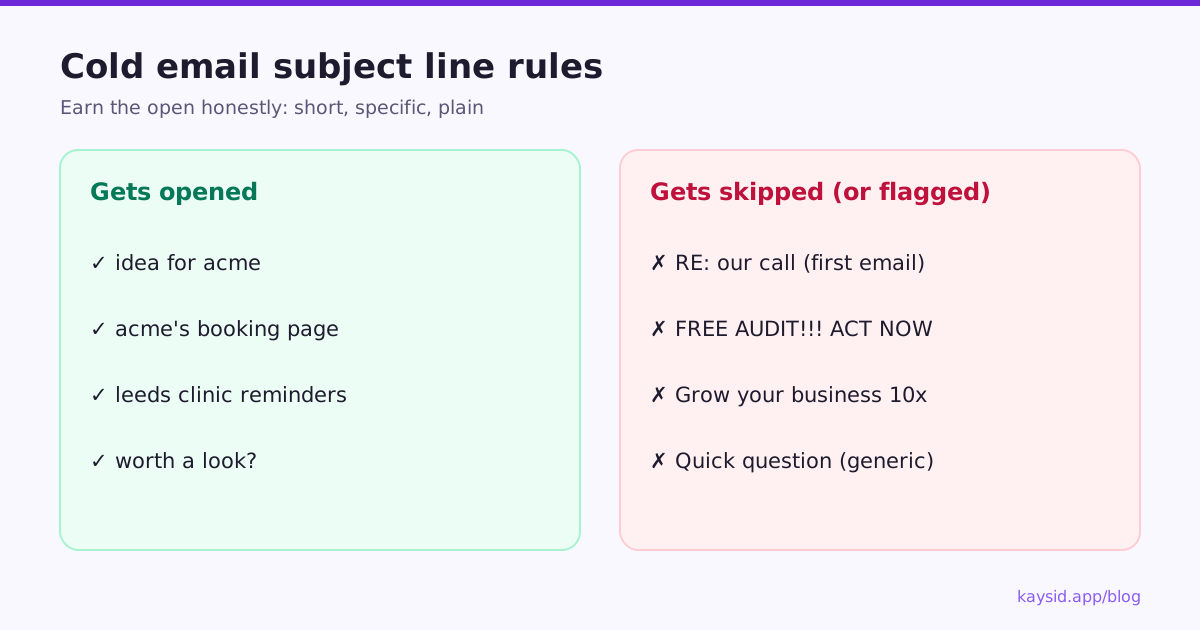
- Short: 2 to 5 words. Most of the subject is cut off on phones anyway.
- Looks internal. Like something a colleague would send: plain, often lowercase, no emojis.
- Specific to them. Their company, their city, their tool, their competitor.
- Honest. It must match the email. "Re:" on a first email or a fake "Quick question about our call" destroys trust and is illegal under CAN-SPAM.
- No hype. No ALL CAPS, no "!!!", no "FREE", no percentages-off.
40 cold email subject line examples
Personalized (they work best)
| Subject line | Why it works |
|---|---|
{{Company}}'s booking page | Names something of theirs; feels like feedback |
idea for {{Company}} | Simple, specific, curiosity without hype |
{{First Name}}, quick question | Classic, but only if the question is real |
{{City}} clinics | Local relevance |
your talk at {{Event}} | Shows genuine research |
{{Competitor}} vs {{Company}} | Competitive curiosity; use carefully |
noticed {{Observation}} | Ties to the opener |
{{Mutual Contact}} suggested I reach out | Only if true |
Problem and outcome
| Subject line | Use when |
|---|---|
missed calls after 6pm | A clear, common pain |
fewer no-shows | A simple outcome |
onboarding in 1 day | A concrete improvement |
security questionnaires | The topic they deal with |
hiring in Dubai | Their current situation |
slow month-end close | A recurring headache |
your Google Ads landing page | A specific, fixable issue |
payroll for remote hires | A process they own |
Social proof
| Subject line | Note |
|---|---|
how {{Similar Company}} did it | Name only with permission |
34% fewer no-shows | Numbers must be real |
clinics like {{Company}} | Peer group without naming |
what worked for {{Industry}} | Industry relevance |
a similar team's results | Safe default |
Question and curiosity
| Subject line | Note |
|---|---|
worth a look? | Low pressure |
right person? | For referral emails |
still a priority? | For trigger-based emails |
open to ideas? | Soft, permission-based |
question about {{Tool}} | If they use a tool you integrate with |
thoughts on {{Topic}}? | Invites their opinion |
10 minutes in {{Month}}? | Only for later follow-ups |
Value-first
| Subject line | Note |
|---|---|
3 fixes for {{Company}} | Promise specific free value |
salary benchmarks for {{City}} | A useful resource |
made you a short video | Only if you did |
free audit, no call | Lower the barrier |
{{Company}} teardown | For agencies and consultants |
a template for {{Task}} | Practical resource |
Follow-ups
Follow-ups usually work best as replies in the same thread with no new subject line: the "Re:" is honest because it really is a reply to your earlier email. If you start a new thread, keep it short:
| Subject line | Note |
|---|---|
| (reply in thread) | Best default for follow-ups 2 and 3 |
one more idea | New angle |
different approach | Restart with a new hook |
closing the loop | Breakup email |
should I stop emailing? | Breakup, very direct |
last note from me | Breakup, polite |
Subject lines that hurt deliverability
| Avoid | Why |
|---|---|
RE: or FWD: on a first email | Deceptive, damages trust, legal risk |
ALL CAPS, !!!, $$$ | Classic spam patterns |
Free, Guaranteed, Act now | Promotional language that filters watch |
| Emojis | Read as marketing in B2B |
| Very long subjects | Cut off, and look like newsletters |
| The same subject to thousands of people | Creates a bulk fingerprint |
How to A/B test subject lines properly
- Test one thing. Two subject lines, same email body, same audience.
- Split leads randomly and evenly between the versions.
- Measure replies, ideally positive replies, not opens.
- Wait for enough data. With reply rates in the low single digits, you need hundreds of sends per version before a difference means anything.
- Test big differences. "idea for Acme" vs "Acme's booking page" teaches you something; "Idea for Acme" vs "idea for Acme" doesn't.
Personalizing subject lines at scale
Merge tags work in subject lines too: {{Company}}, {{City}} or a custom column like {{Topic}}. Three practical rules:
- Always have a fallback. A blank company name turns
idea for {{Company}}intoidea for. Use a fallback or check every lead before sending. - Match the subject to the first line. If the subject mentions their booking page, the first sentence should too.
- Write a subject per lead when you write an email per lead. If an AI assistant drafts each email, have it draft the subject from the same observation.
Subject line ideas by industry
| Industry | Example subject |
|---|---|
| Dental and medical clinics | new-patient calls after 6pm |
| Ecommerce | {{Company}}'s checkout on mobile |
| B2B SaaS | {{Company}} + {{Integration}} |
| Recruiting | your talk on {{Topic}} |
| Real estate | listings in {{Neighbourhood}} |
| Local services | {{Company}} on Google Maps |
| Finance and accounting | month-end at {{Company}} |
Notice the pattern: every one names something that belongs to the reader. That's what makes a stranger's email feel relevant before it's even opened.
A simple formula when you're stuck
[Their thing] + [your topic], in lowercase, under five words. For example: acme's onboarding emails, leeds clinic reminders, your shopify checkout. It's specific, it's honest, and it looks like a colleague wrote it.
Frequently asked questions
What is the best subject line for a cold email?
A short, specific, lowercase subject that refers to the recipient's company or situation, such as "idea for {{Company}}". There's no single best line; relevance beats cleverness.
How long should a cold email subject line be?
Two to five words. Short subjects display fully on phones and look like internal email.
Should I use the person's name in the subject line?
It can help, but their company or a specific observation is often stronger, because many marketers already use first names.
Is it okay to use RE: in a cold email subject line?
Only when the email is genuinely a reply in an existing thread, such as a follow-up. Using RE: on a first email is deceptive and can break laws like CAN-SPAM.
How do I know which subject line works best?
A/B test two versions with the same email body and compare replies after a few hundred sends each. Open rates are unreliable because of privacy features.