Strategy
How to Get Clients With Cold Email: A Playbook for Agencies, Freelancers and Consultants
By Kaysid Team · · 5 min read
Referrals are wonderful until they stop. For agencies, freelancers and consultants, cold email is one of the few ways to create new client conversations on demand, without ad spend and without waiting for someone to remember your name.
But it only works if you treat it as a system: a narrow audience, an offer that's easy to say yes to, a clean list, emails written for each prospect, and fast follow-through when someone replies. This playbook walks through each step, with examples.
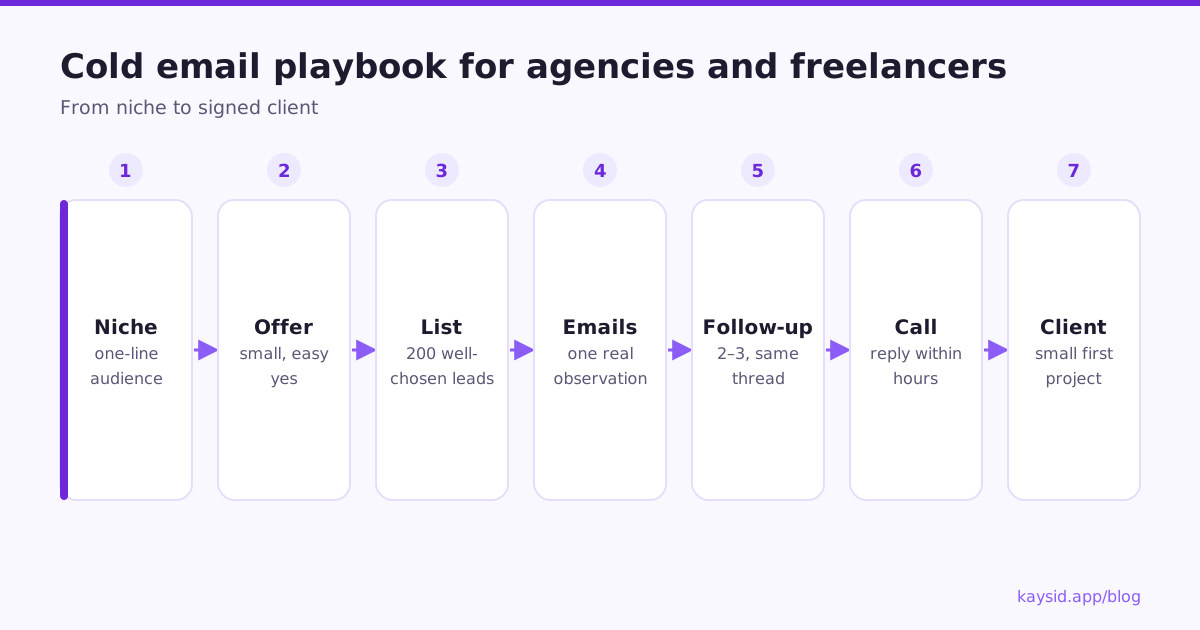
Step 1: Pick a niche you can describe in one line
"We help businesses grow" can't be personalized, targeted, or remembered. "We build booking websites for physiotherapy clinics in the UK" can. A narrow niche makes every later step easier: you know where to find leads, what problems they have, and what proof will convince them.
| Too broad | Specific |
|---|---|
| Marketing for small businesses | Google Ads for roofing companies in Texas |
| Web design | Shopify speed fixes for fashion stores doing $1M–$10M |
| Consulting | Payroll setup for startups hiring their first UAE employees |
| Content writing | SEO articles for B2B cybersecurity SaaS |
Step 2: Build an easy-yes offer
Nobody signs a $5,000 retainer from a cold email. The goal of the first email is a reply, then a conversation. So lead with something small, specific and low-risk:
- A free mini-audit with three specific fixes, delivered as a short video or document.
- A teardown of their ads, website or funnel.
- A small paid pilot with a clear outcome and price.
- A useful resource built for their niche: benchmarks, a checklist, a template.
Step 3: Build a targeted lead list
Aim for quality over quantity: 200 well-chosen prospects beat 5,000 random ones. For each lead you want the decision-maker's name, work email, company, website, and anything that helps personalize (location, a recent event, what they sell). See How to build a B2B lead list for sources and cleaning.
- Decision-makers: owners and founders for small businesses; heads of marketing, growth or operations for larger ones.
- Signals: hiring for a role you could replace, running ads, launching something new, poor reviews about a problem you solve.
- Verify emails before importing, and skip shared inboxes like info@.
Step 4: Write an email for each prospect
The best-performing agency cold emails show that you've already looked at their business. One specific observation is worth more than any amount of credentials.
Subject: {{Company}}'s Google Ads
Hi {{First Name}}, I searched "emergency roof repair {{City}}" and {{Company}}'s ad sends people to your homepage instead of a page about emergency repairs. That usually costs a lot of calls. We run Google Ads only for roofing companies; three of our clients are in Texas. Want me to record a 3-minute video with the fixes I'd make? No call needed. {{Sender Name}}
The observation must be real and checked. This is where AI research can help at scale.
To do this for hundreds of prospects, research each one (manually or with an AI assistant that can browse), write a personal first line or a full email per lead, and keep them in a spreadsheet. Our AI personalization guide explains the workflow.
Step 5: Follow up, briefly
Plan two to three follow-ups over two weeks, as replies in the same thread, each adding something new:
| Day | Follow-up idea |
|---|---|
| 3 | A second observation or quick win |
| 7 | A short result from a similar client |
| 14 | A polite breakup: "I'll stop here; reply anytime" |
More examples in How to write a follow-up sequence.
Step 6: Handle replies fast
Speed matters more than most people think. A prospect who replies "sure, send it" is interested now; three days later, the moment has passed.
- Interested: reply within hours. Deliver the audit or video you promised, then suggest a call.
- "Not now": thank them, ask if you can check back in a specific month, and set a reminder.
- "Not interested": thank them and stop. Never follow up after a no.
- "Talk to X": that's a referral. Email X, mentioning who suggested it.
Step 7: From call to client
- On the call, ask about their goals and what they've tried before you pitch.
- Propose a small first project with a clear outcome and price.
- Send the proposal the same day.
- Follow up once or twice if they go quiet, then move on.
What results to expect
Cold email is a numbers game played with small numbers. A typical path: a few hundred well-chosen prospects → a handful of positive replies → a few calls → one or two new clients. If those clients are worth thousands each, a campaign of a few hundred emails a month can pay for itself many times over. The levers are always the same: a sharper niche, a better offer, more specific emails.
Mistakes agencies make
| Mistake | Fix |
|---|---|
| Pitching services instead of outcomes | Lead with a specific problem and result |
| Credentials-heavy emails | Swap "we're an award-winning agency" for one observation about them |
| Big asks in the first email | Offer something free and small |
| Sending from the agency's main domain | Use secondary domains |
| Slow replies to interested prospects | Check replies daily; reply within hours |
Running this playbook in Kaysid
- Import a spreadsheet with one written email per prospect, or use one template with merge tags.
- Review every email before launch: empty fields, placeholders and near-duplicates are flagged.
- Send from your own mailboxes at a human pace, with follow-ups in the same thread.
- Replies stop the sequence automatically and land in one inbox, where you label them.
- The Overview shows what needs you today: replies to answer, campaigns that need attention, emails to write.
Frequently asked questions
Does cold email work for agencies?
Yes, when the niche is narrow, the offer is easy to accept (like a free audit), and each email shows real research about the prospect's business.
How many cold emails do I need to send to get a client?
It varies by niche and offer. Many agencies find that a few hundred well-targeted emails produce several conversations and one or two clients. Measure your own numbers and improve from there.
What should an agency offer in a cold email?
Something small and specific: a mini-audit, a teardown video, a few concrete fixes, or a short paid pilot. Avoid asking for a big commitment in the first email.
Should freelancers use cold email?
Yes. It's one of the most direct ways for freelancers to reach clients without platforms or ads, as long as emails are personal and targeted.
How do I find leads for my agency?
Use directories, Google Maps, LinkedIn, job boards and B2B databases filtered by your niche, then verify the emails before you send.